
Heat pump testing — how fast does it heat?
Show 0 more photos Show 3 more photos Hide additional photos
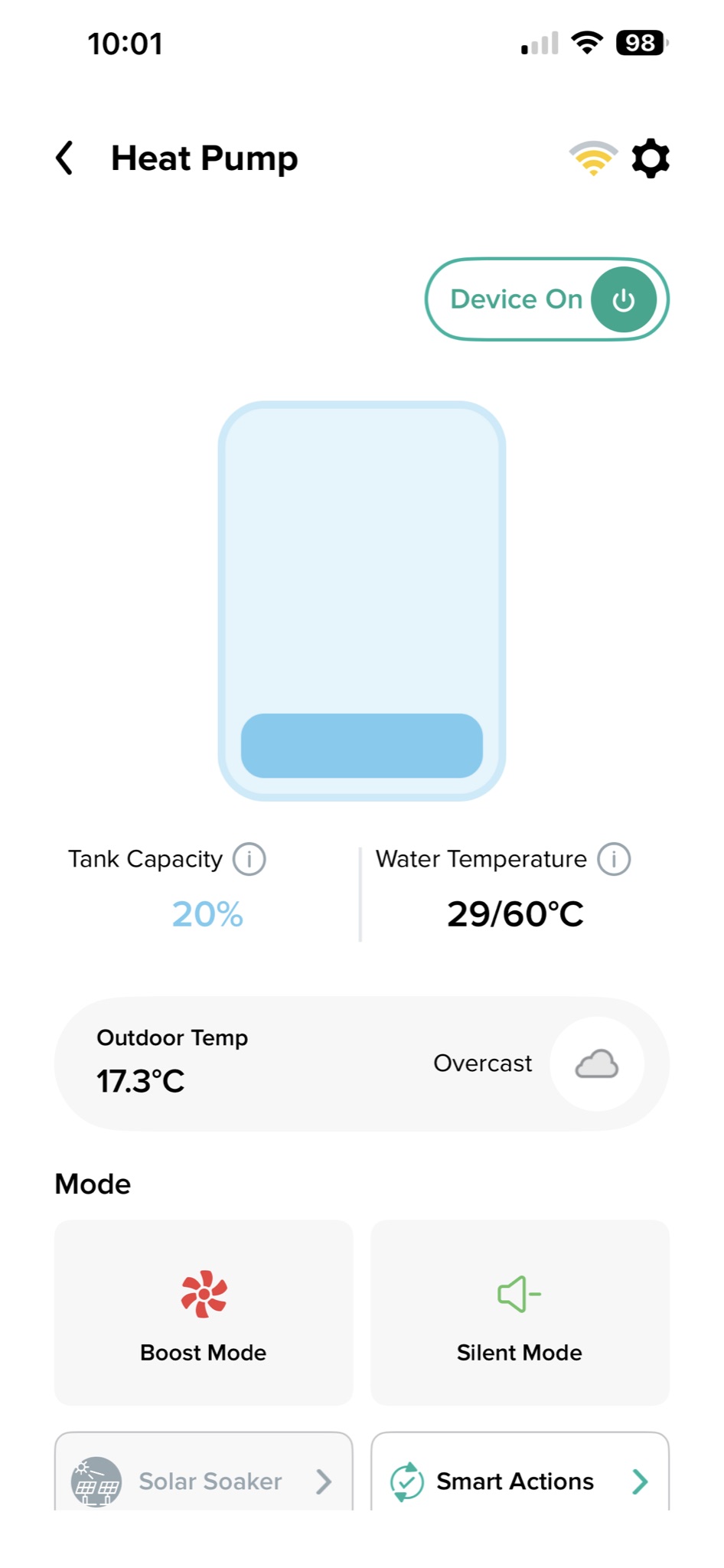
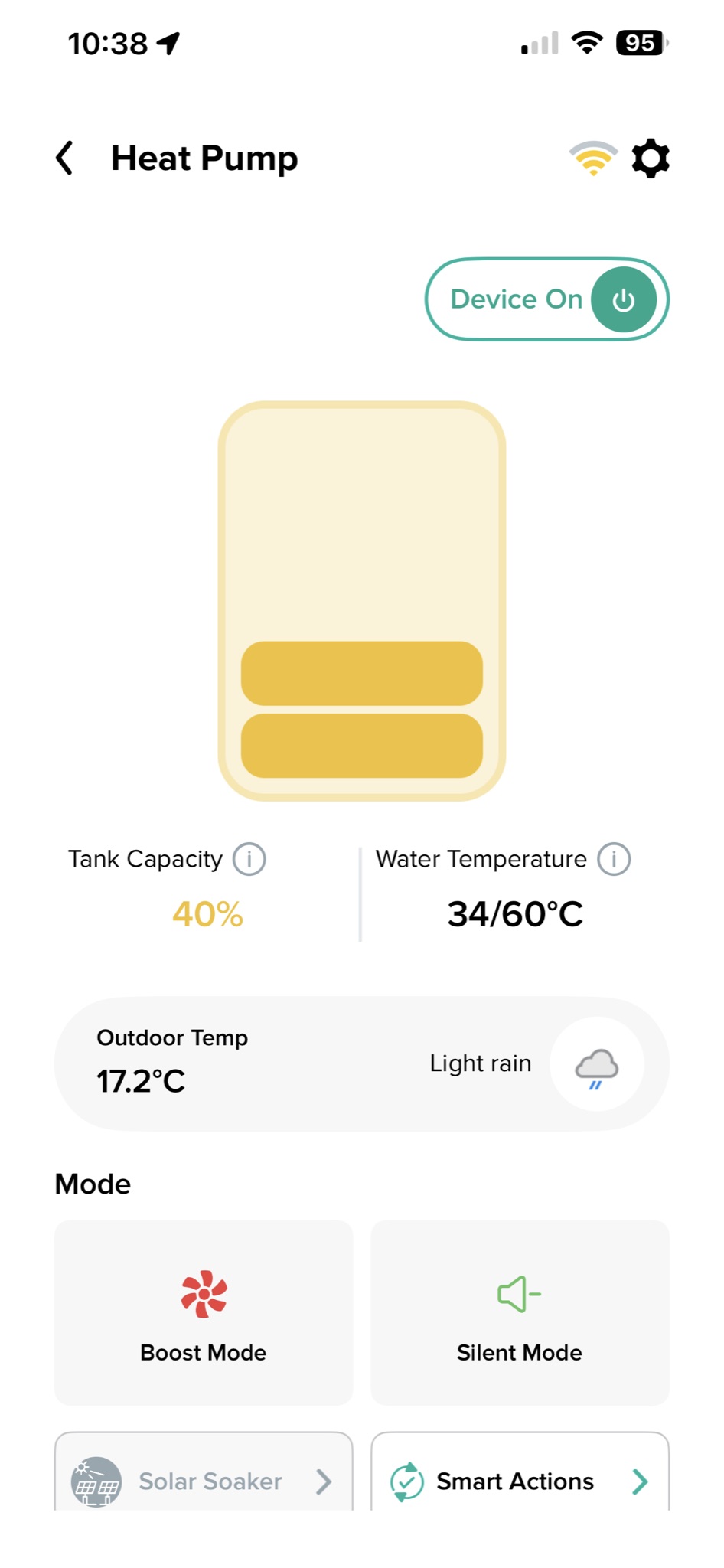
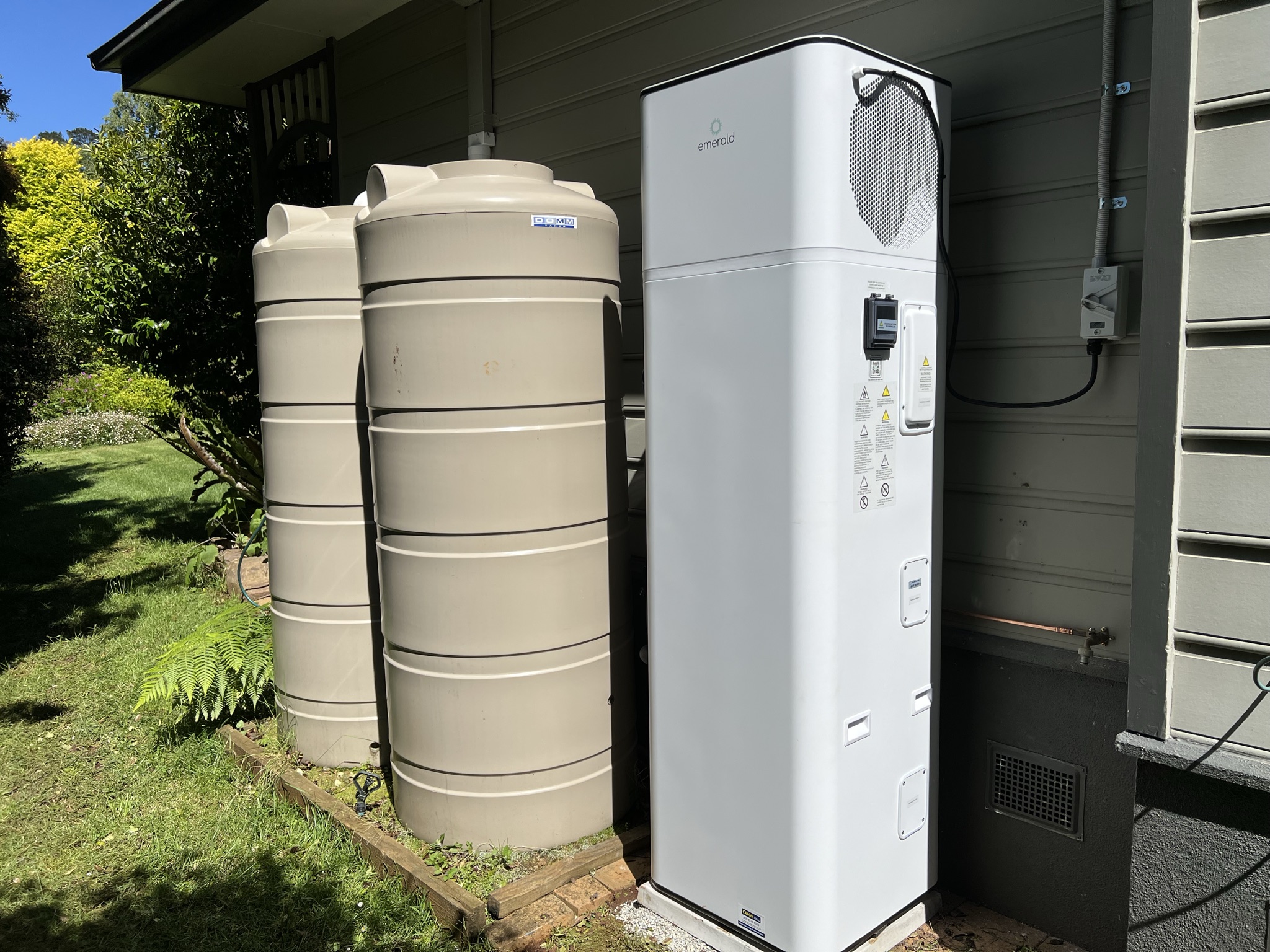
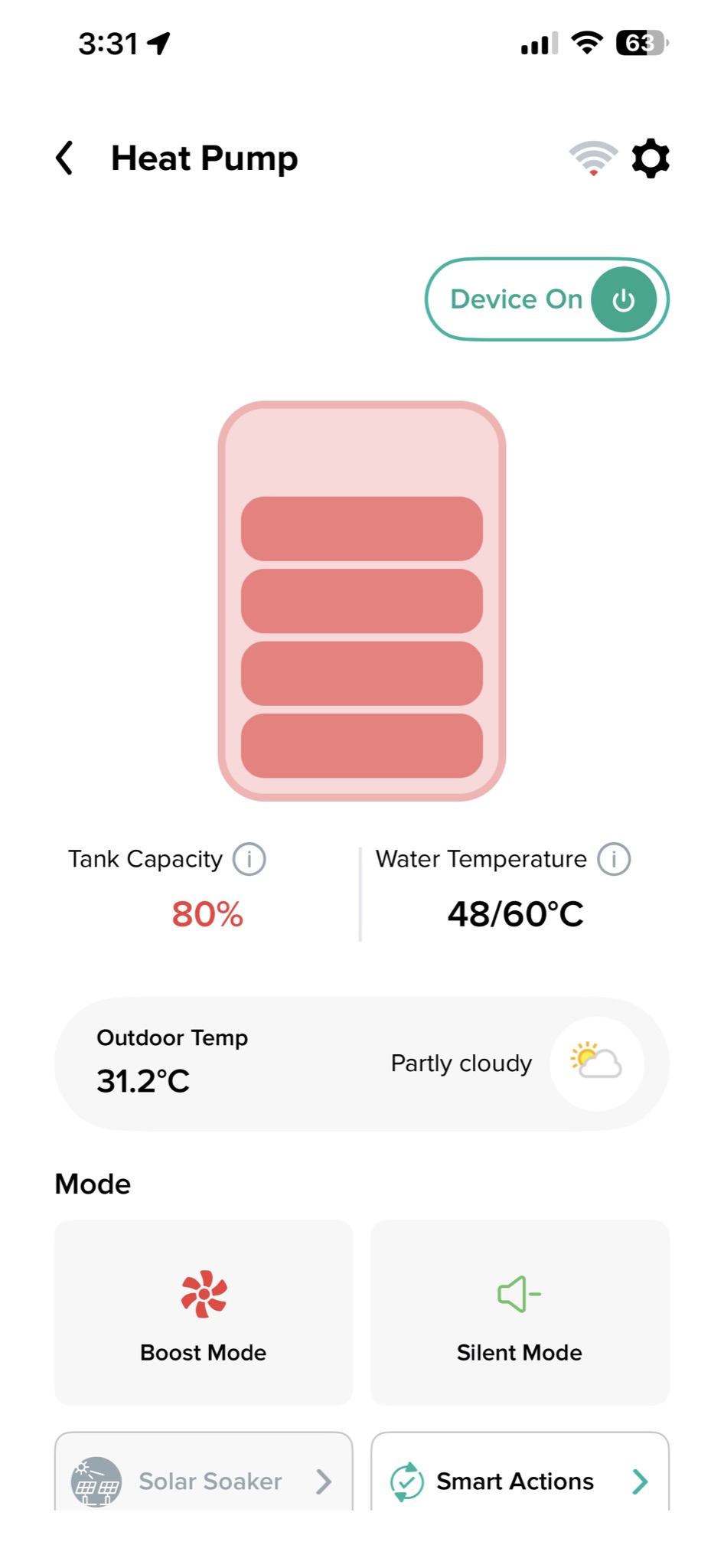
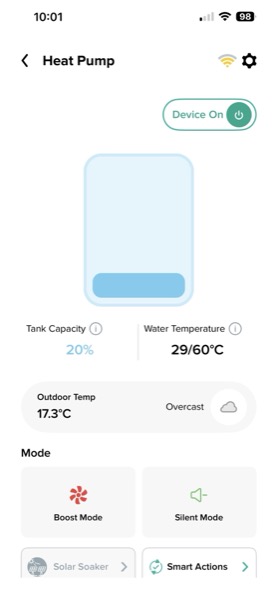
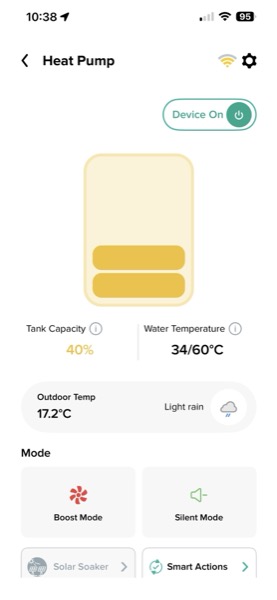
In my December post about our heat pump installation, I mentioned that one of the reasons I chose Emerald was the integrated app. It shows the tank capacity, water temperature, outdoor temperature, and lets me turn it on and off or activate Boost Mode remotely. I've since used it to answer a question: how long does it actually take to heat the water, and does outdoor temperature make a difference?
Over the past couple of months, I've been taking semi-random screenshots of the Emerald app at intervals through the day, tracking the water temperature as it heats from "Low" (around 25–30°C) up to the 60°C target. I did this on 11 different days, with outdoor temperatures ranging from about 14°C to 32°C.
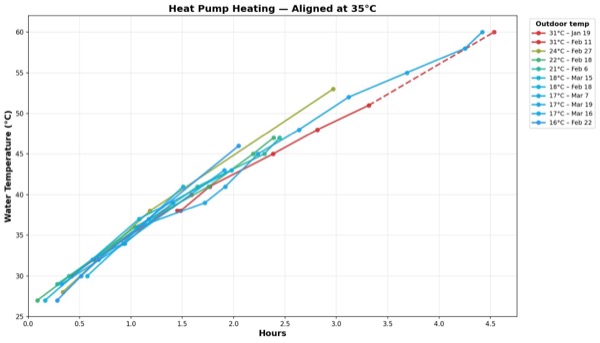
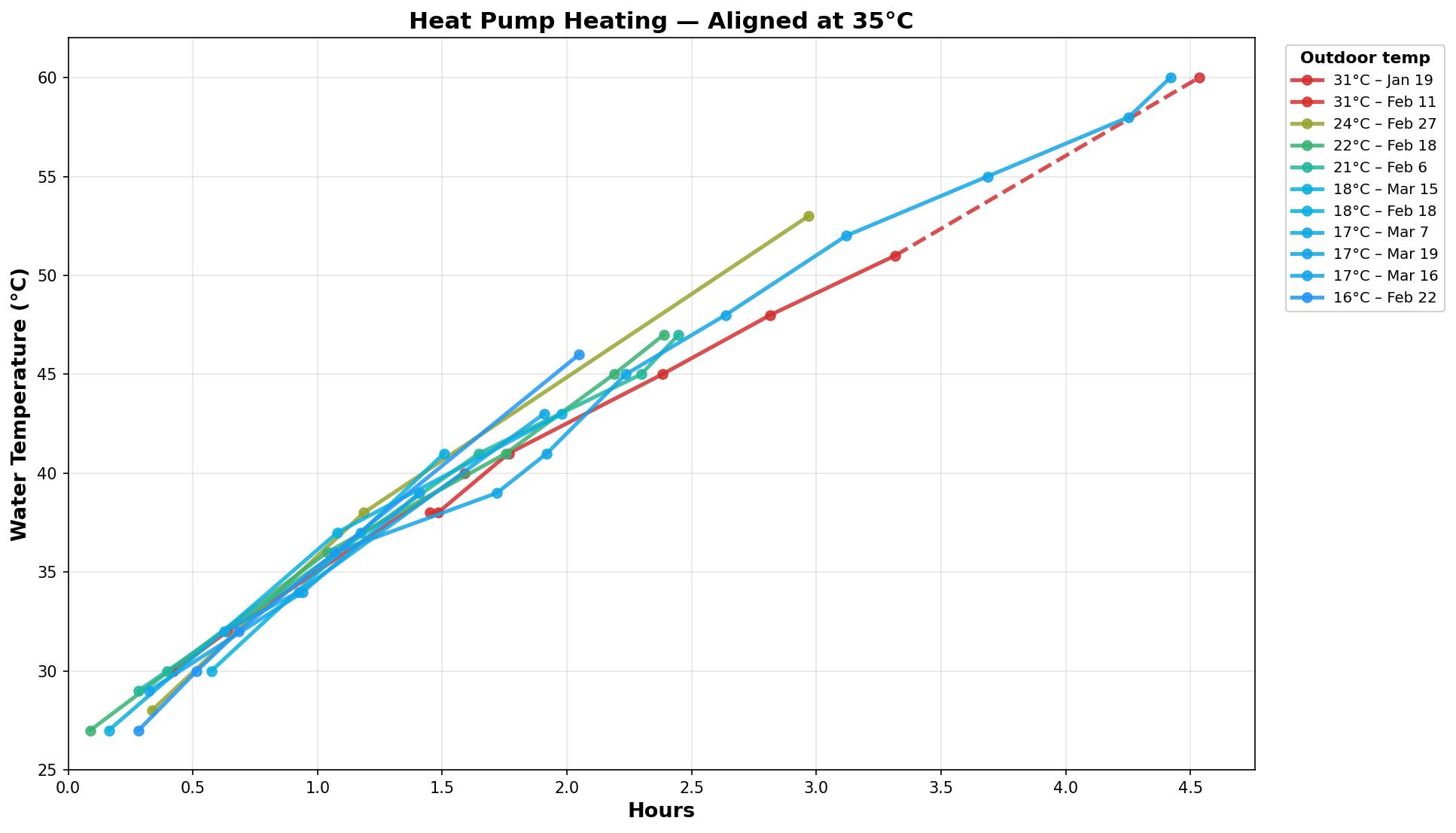
I then used AI (Claude, by Anthropic) to read all 87 screenshots, extract the data, and plot it on a chart. The chart shows each day's heating curve overlaid, with the lines colour-coded by outdoor temperature — red for hot days, blue for cool days. We might expect to see the warmer days heating much faster, since a heat pump pulls heat from the outside air. The hotter the air, the more heat available to pump, right?
Well, the data didn't really show that. The heating rate is remarkably consistent regardless of outdoor temperature. Whether it was a 32°C summer day or a 14°C evening, the heat pump heats at roughly 8–10°C per hour. There's some variation day to day, but it's mostly noise from my irregular screenshot timing rather than a clear outdoor temperature effect.
In hindsight, this makes sense when you realise that the heat pump shifts thermal energy, which is roughly proportional to the absolute temperature, which is measured in Kelvin, rather than Celsius. Here are some technical figures (that you can skip): 0°C is not actually zero heat — it's 273 Kelvin. So, when we say it's 14°C outside, that's 287K, and 32°C is 305K. That outdoor range of 18 degrees Celsius sounds big, but it's only about a 6% difference in the actual amount of thermal energy in the air. Similarly, heating water from 25°C to 60°C sounds like you're more than doubling the temperature, but in Kelvin that's 298K to 333K — only a 12% increase. The heat pump is working across a relatively narrow band of absolute temperatures, so its performance stays fairly consistent. You'd probably need to test in near-freezing conditions to see a noticeable drop in heating rate.
This is good news. It means the heat pump performs consistently in the range of conditions we get here in the Dandenong Ranges (Emerald, VIC). On a typical day, starting from low/empty, it takes about 3.5 to 4.5 hours to heat the full 320L tank to 60°C. That's comfortably within a day's solar generation window.
I also checked whether the pump slows down as the water gets hotter — you might expect it to struggle more pushing heat into an already-hot tank. Nope. The heating rate is essentially flat from 27°C all the way to 60°C. The pump just chugs along at the same pace regardless.
A few practical observations from three and a half months of use:
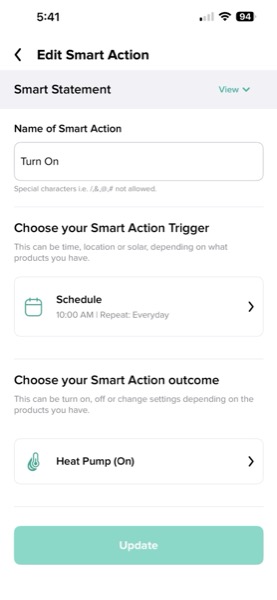
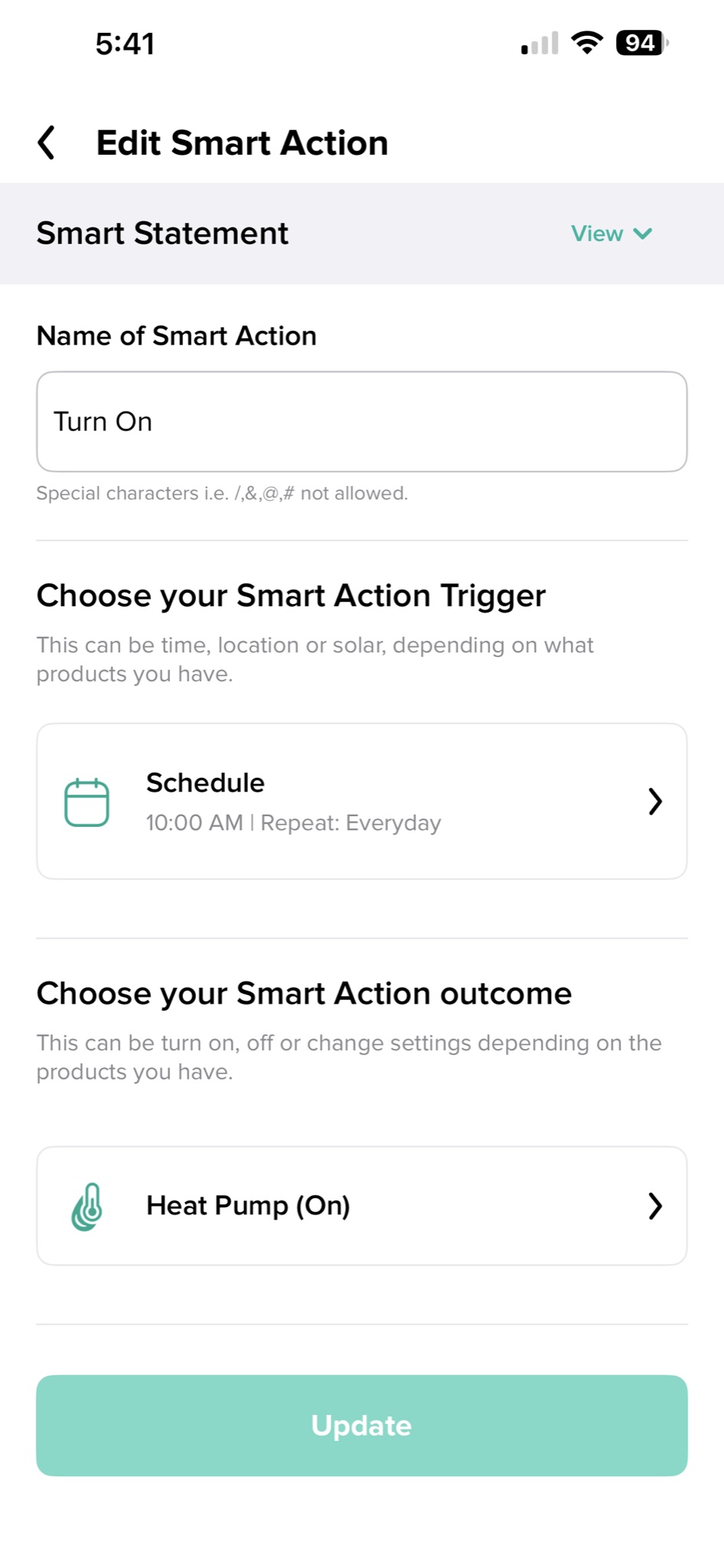
- I've set the app's Smart Actions to heat between 10am and 8pm each day, which lines up nicely with our solar generation and means the fan noise won't disturb anyone sleeping. I had some early issues with the Smart Actions not triggering reliably, but I fixed that by improving the WiFi signal to the pump and setting the triggers to retry after five minutes.
- Even when the app shows "Low" water temperature (below 30°C), the shower is actually hot. I think this is because the temperature sensor is in the middle of the tank, but hot water rises to the top, so the water drawn from the top of the tank is hotter than what the sensor reads.
- We currently have three adults in the house, and we had four for two weeks. A couple of people sometimes take pretty long showers. We have not run out of hot water, except when I forgot to turn it on after testing. We should probably install some water-saving shower heads though, because we're going through a lot of water.
- The only time I used Boost Mode was on day one, just to test it. Never needed it since.
Related Posts
- Heat pump installation 3 Dec 2025
- Series — solar, battery, electrification: Solar, battery and electrification — series intro 4 Dec 2025
- Later — the gas went off altogether Off the gas for good 30 Jul 2026
Report
Report
Report
Report
Report
Report
Report
Report
Report
Report
Report
As you are only seeing one temp and that sensor isn't at the top of the tank the estimate of how much used is rather vague.
320L at 60degC in summer mixes with 320L at 20degC to give you 640L shower temp hot water in the middle. Call that 65minutes under a 9.5L/min showerhead.
Winter time with cold at 10 degC can mix half as much giving you 480L at 40degC
The recovery rate for a 2.8kW Heatpump is around 66L/hr in 20deg Ambient temps.
Up at 32 deg ambient it should be ~25% higher and down at 7degV it should be ~25% lower but the unit should be able to hide some of that with its inverter drive.
Relative humidity has a massive impact on performance as wet air carries more energy than dry air.
Without that piece of data the temperature doesn't mean much.
Eg Aquatech use Wet bulb (google it) temp which is effectively the temp of a thermometer wrapped in a wet cloth.
To get 20deg wet bulb it needs to be ~30deg ambient and the performance appears better than it is for other manufacturers just quoting 20degC at 50%RH.
Performance is typically measured heating a full tank capacity 15-60 degC.
This isn't possible in summer as with an inlet temp of 20degC and residual heat in the tank it ends up being a heating cycle 25 -60deg instead
Ie 35 vs 45 deg temp rise over 320L is significantly different amount of energy. (Extra 3.76kWh which is another 3.76/2.8 kW heating power at 20degC = another hour and 20mins of heating required)
Looking fwd to your winter results.
Summer is easy, can heat water with a piece of garden hose in the sun.
Winter different story !
Here have a play
Water Heating Calculator https://share.google/X4PcGyCr15GAXwBDP
Report
Report
Does your Emerald app not communicate with your heat pump? Did you manage to connect it originally?
Report
4.5hrs of heating on a 31⁰C day
- heating 320L of water from 25-60⁰C = 13.04kWh energy required.
Water Heating Calculator https://share.google/KzIbXNKlbiN0fKlGc
Without an accurate measure for energy remaining in the tank there is some guesswork involved but the lines line up with the spec sheet re achieved heating power.
(Summer cold water is 20C but won't go below 25 as thermal inertia in the steel and remaining water)
Achieved heating power 2.89kW which is as per the spec sheet 2.8kW give or take graphical error me reading the dots.
Works as advertised.
You won't see much of a decline in performance until 6-7Deg ambient when it gets close to freezing the evaporator.
Down there it will have lost ~20% of its performance and be down to 2.25kW heating power.
The changes in the lines you see are affected as much by the relative humidity as the temperature hence if you are only measuring one variable and not both a conclusion regards to temperature affecting reheating rate cannot be made.
More water in the air = more energy in the air.
Warmer air can carry more water but on warm days we have northerly winds which are much dryer than southerly winds which by way of travelling over water to reach us are much higher in humidity vs Northerly winds coming across the desert to reach us.
As for determining the amount of energy stored in the tank
You need alot more than 1 thermocouple due to the stratification of hot and cold water in the tank.
If the whole tank is heated to temp and used in one hit the top tank temp will remain close to 60 for the full volume of the tank but when left to cool it will cool evenly across the volume.
EG tank looses 9⁰C with no-one using any hot water
Top temp middle temp and bottom temp will go from 60 to 51.
But if instead you simply take 60L of hot water out the top will still be at 60 but the bottom will be at 15⁰C.
In both cases the amount of energy taken out of the tank is the same but the thermocouples tell the story differently as one has been replaced with cold water stratified on the bottom and the other has simply cooled the entire volume equally as the tank has lost the energy to all sides vs out the top and replaced with cold.
Whilst those are the two extremes of how it works, inevitably there are both things happening concurrently and the tank will loose more temp when it's hot vs cold ie standing losses daily would be less if you simply heated and used vs heated waited 16hrs then used.
For three adults it should manage to heat enough water for normal water users 11-3pm.
- that's the most efficient time as it's warmest outside and off peak and 11-2 free period = best time.
Hope this helps you refine the hypothesis.
- need input power
- need humidity sensor
-need better tank temp sensor position advice ie where is it or is there top and bottom
Report