
Why is our bigger Tesla more efficient?


Show 1 more photo Show 7 more photos Hide additional photos

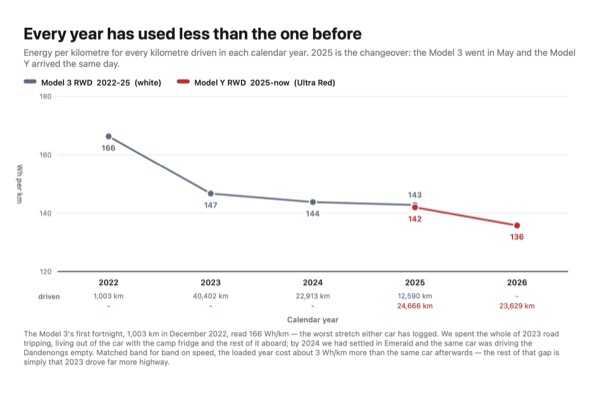


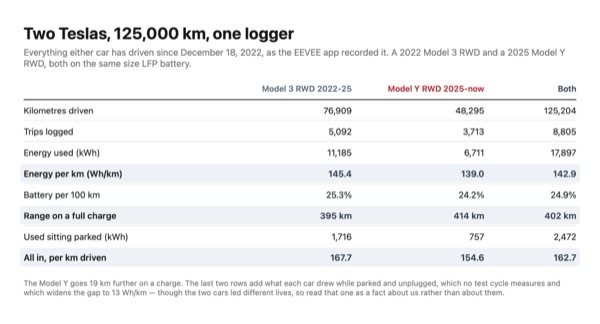


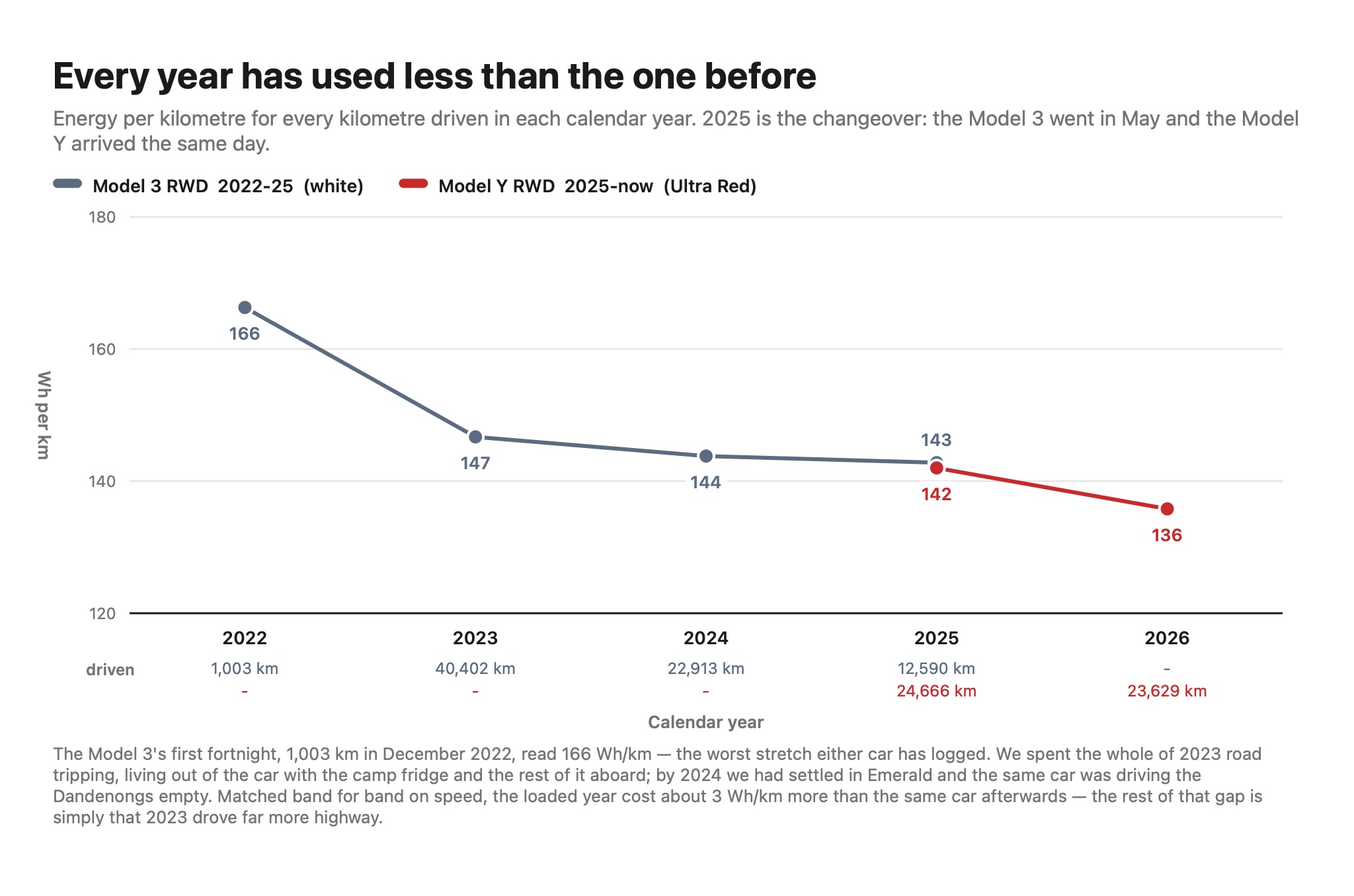


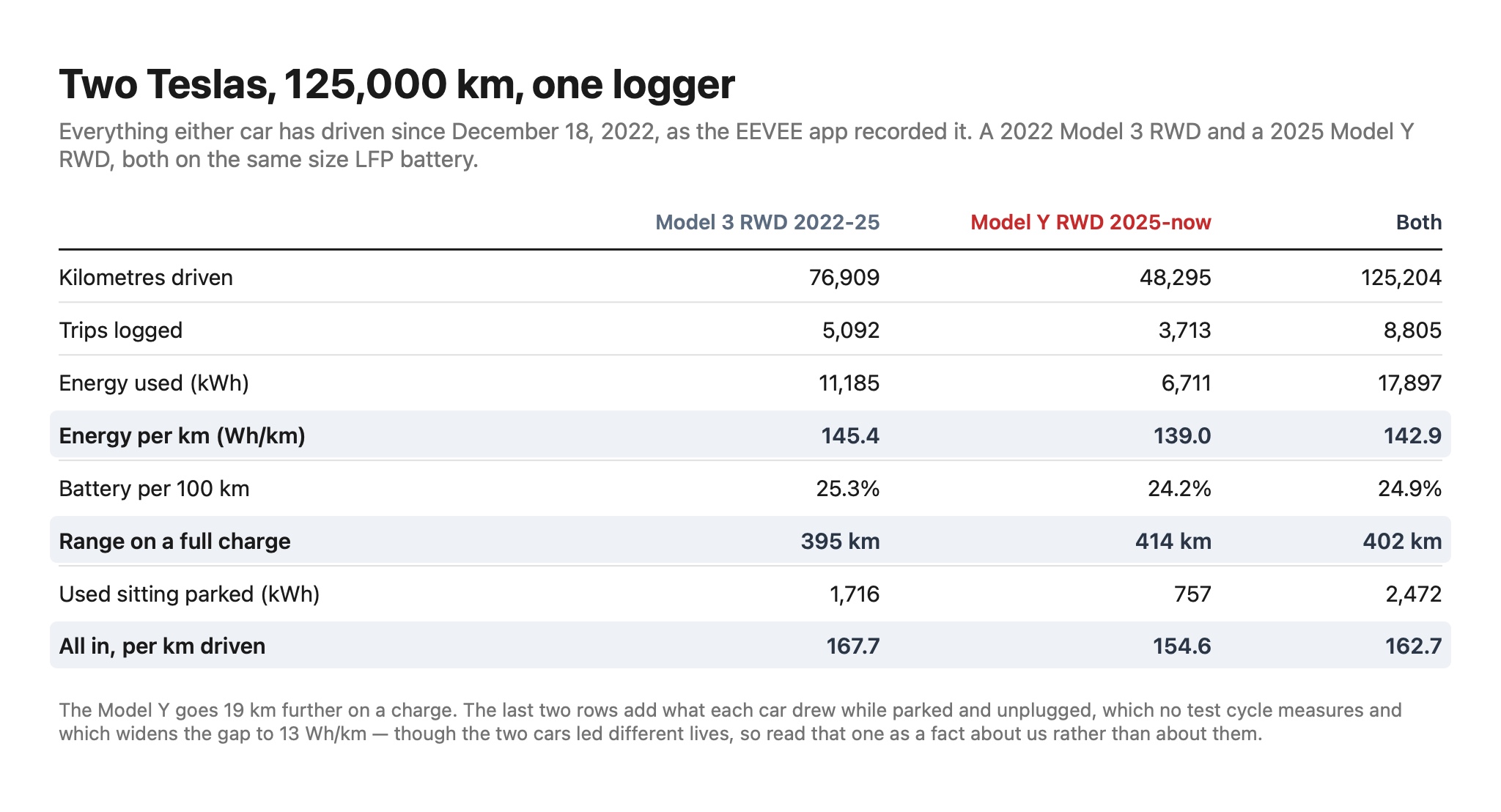
Our Model Y is taller, wider and heavier than the Model 3 it replaced, and it rolls on 20-inch open wheels where the Model 3 had 18s under aero covers. All of that should cost it energy. But, somehow it uses less: 139 Wh/km against the Model 3's 145. We are not sure why.
Somebody asked about it on our last post, and it is worth chasing: efficiency was one of our main criteria when we went looking for a new car. The Kia EV5 was roomy and boxy and poor on efficiency. The XPeng G6 came closest, and matched the Model Y on claimed efficiency. We stayed with Tesla for the storage, the drive and the tech.
Both our cars were/are the standard range RWD, the entry model, and we bought them that way on purpose: we wanted to know whether the most basic EV covers what most people actually drive. It does. Tesla now sells a Model 3 Long Range claiming up to 750 km.
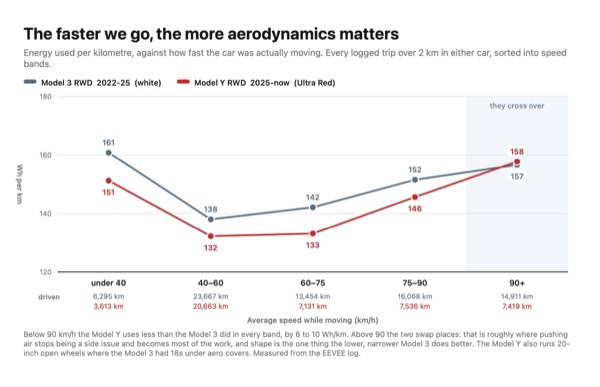
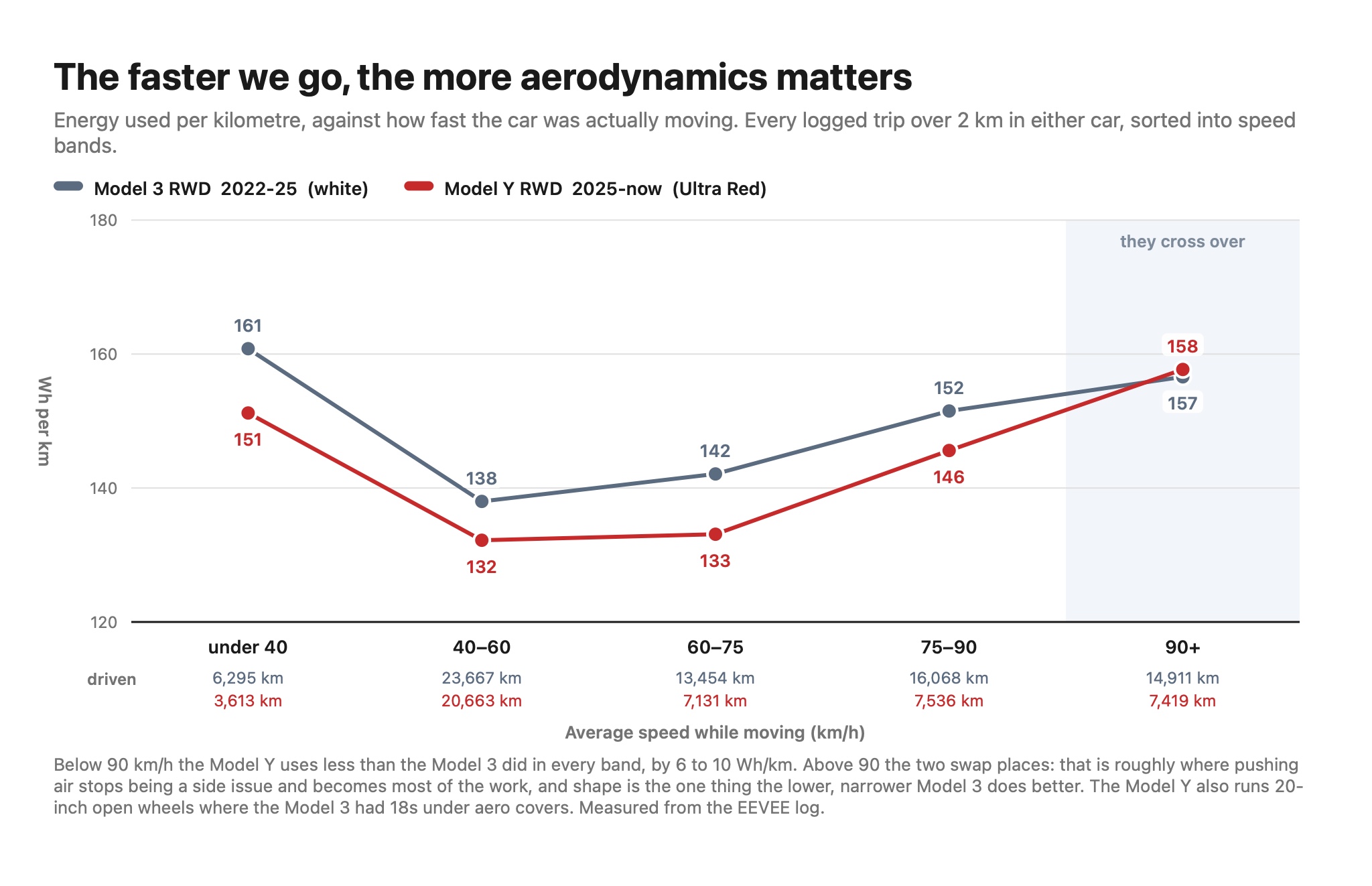
The log does show where the difference is. Sorting all 125,000 km by how fast each car was moving at the time, the Model Y uses less in every speed band below 90 km/h, by 6 to 10 Wh/km. Above 90 they swap places: the faster we go, the more aerodynamics matters, and shape is the one thing the Model 3 does better. So whatever the Model Y is doing better, it is not about air.
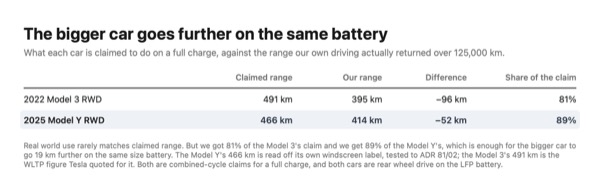
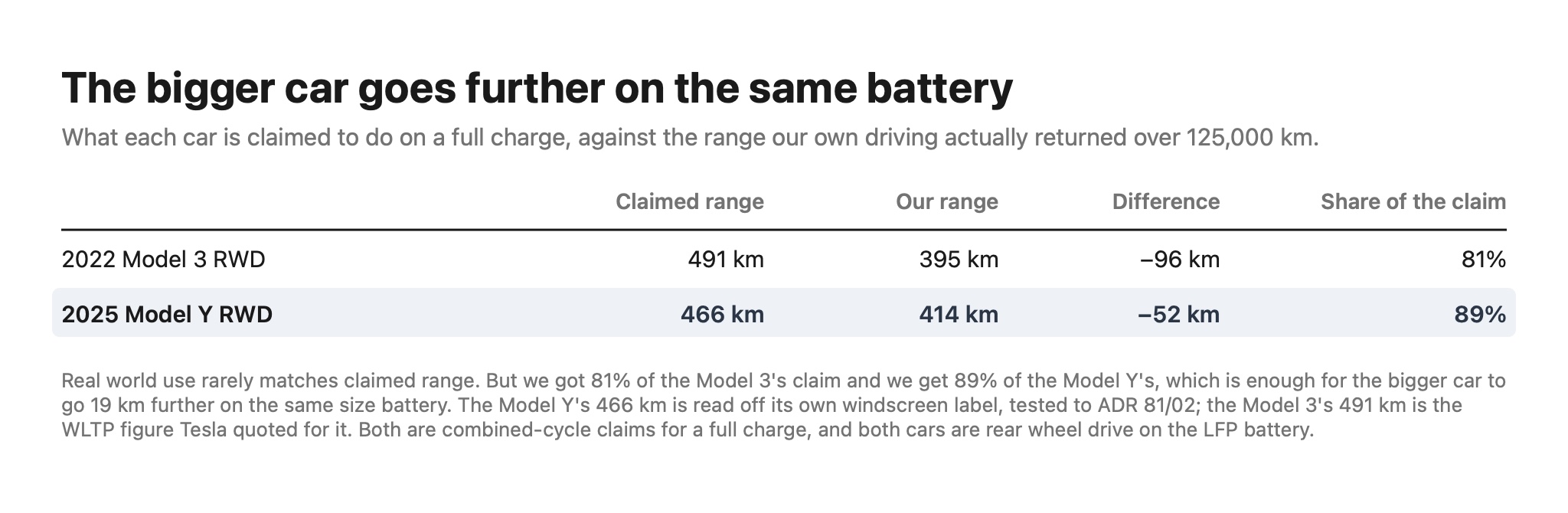
The brochures say the opposite. Our Model 3 was quoted 491 km on a full charge, and our Model Y's own windscreen label says 466. Our driving gave the Model 3 395 km and gives the Model Y 414.
Real world use rarely matches claimed range. But we got 81% of the Model 3's claim and we get 89% of the Model Y's. Same size battery, bigger car, 19 km further.
Does anyone know why our Model Y gets further on the same juice?
Charging
All of this comes out of EEVEE, the app that has logged both cars since December 18, 2022 — 125,204 km of travel. It works out energy from the battery percentage, so what it really measures is how much battery a kilometre costs. That only compares fairly if the two batteries are the same size, and these are: 62.3 kWh against 62.5.
Related Posts
- Where this came up — the comment on our last post: The places an electric car has taken us 16 Nov 2026
- Why both cars run the same chemistry: Lithium ion, or lithium iron? 11 Jun 2026
- The Model Y L, which is bigger again and less efficient per kilometre: Does size matter? Tesla Model Y vs YL. 25 Apr 2026
- What we were weighing up when we ordered the Model Y: Why we ordered a Model Y 'Juniper' launch edition 14 May 2025
- Farewell to our 2022 Model 3 14 May 2025
- One of the cars we ruled out, partly on efficiency: Kia EV5 test drive: bouncy brick 1 Feb 2025
- The one that came closest: XPeng G6 — second test drive 25 Mar 2025
- An earlier go at driving efficiently, with a soup cauldron aboard: How to drive efficiently with a soup cauldron 23 Mar 2025
- If you are weighing up a first EV: Thinking about an EV? Here's what surprised us 19 Jun 2026
Report
Report
Report
Ours does 13.5kwh/100
Report
Report
Report
Report
Report
Report
EG new base model Tesla gets longer range than the RWD premium.
They make the sidewalls stiffer and the treads harder and with more gaps
This has less rubber on the road less grip and less drag.
Personally I don't think it's worth it I run my cars around with flat tyres 3P I run at 36psi on 18" wheels
The ride is better, the grip is better, even wear across the treads is better but the efficiency is less.
If I run it around at 46psi cold on Hankook ion EVo AS 600 TW tyres it would do 140Wh vs the 180Wh I get now.
Simply not a sacrifice I'm prepared to make.
Report
Report
Your model 3 likely came with a pilot Sport4 a ripper performance tyre that's built to make the car grip and handle not something to get a number on a brochure.
If your current car has Hankooks they are rubbish in comparison for performance and grip but excel for tread wear and efficiency
Report
The Y isn't on Hankooks though. Michelin Pilot Sport EV, 255/40R20. Tesla's service message gave us the brand and size when we had the flat last Christmas, and the sidewall in our own photos says Pilot Sport EV.
So, same family, different job. The 3's tyre is built for grip. The Y's is Michelin's EV version, built to trade a little of that for range.
Whether it explains the whole 6.4 Wh/km is another matter. Both tyres carry a B on the EU label for rolling resistance, which puts them within about 1 kg/t of each other, and the Y is 90 to 160 kg heavier. That gets us maybe half to three quarters of the way, not all of it.
It does land where you'd expect, though. The Y is ahead in every speed band under 90, and behind above it. Rolling resistance at low speed, aerodynamics at high. So, tyres are the biggest single thing we can point at, and you got there first.
The Model 3 tyre replacement, if you're curious:
New tyres for our Tesla Model 3
Report
Report
Report
It’s just down to great engineering I guess.
(I’m blown away with the efficiency of the Y.)
Report